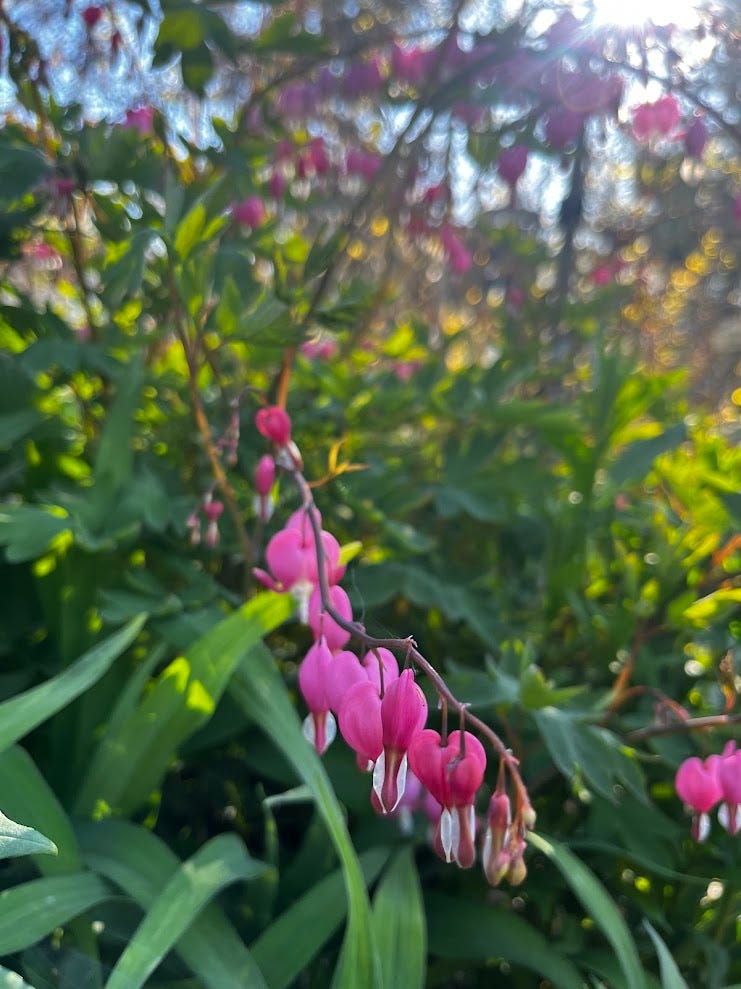
On Natural Intelligence (1/3)
friends don't let friends use AI, or at least without reminding them to use responsibly

A short reflection tonight, because I am exhausted and coming down with a cold, but I want to get started one what will probably be a blog mini-series.
Today my 12-year-old and I went to his semi-annual appointment at the allergy clinic outside La Crosse, about 2.5 hours away. Because of road closures, the GPS sent us the slightly longer but much more scenic route there, winding beside the Mississippi along the Minnesota-Wisconsin border.
It was a truly lovely time of year to make the drive. The whole spectrum of spring greens was glowing in the patchy sunlight, accented with vibrant fuschias and purples of interspersed crabapples and lilacs. The bluffs overlooked tumbling stream into placid river, with red-winged blackbirds darting among the reeds.
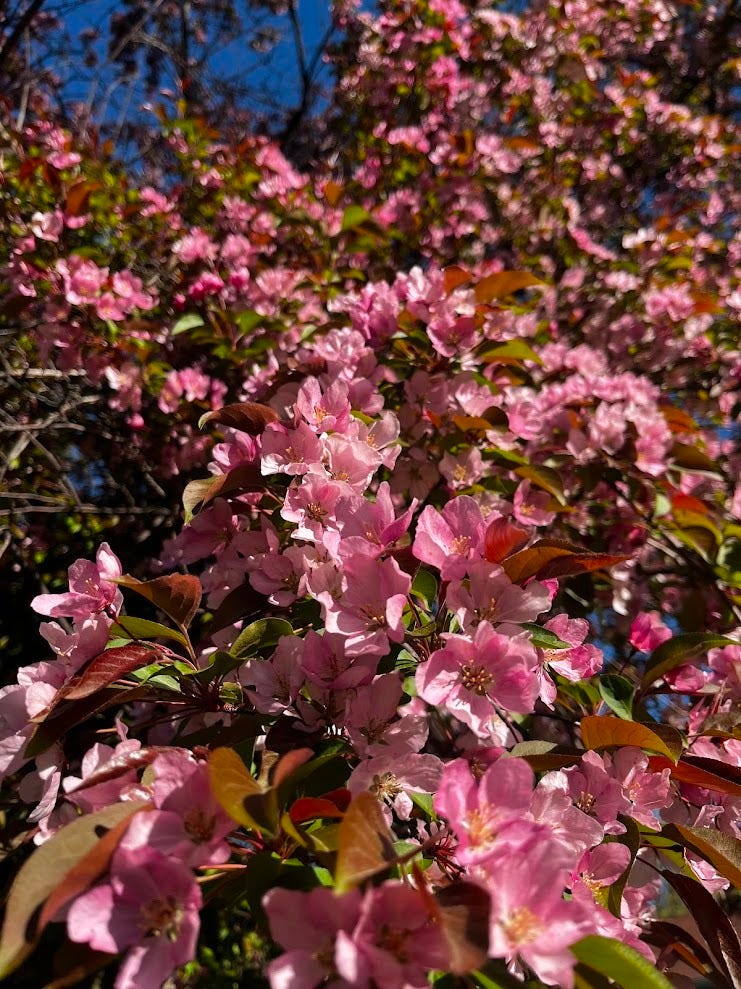
Such beauty makes my heart ache. I long to inhabit it, I fear how it’s threatened, and I mourn how much we’ve already ransacked it.
And I’m aware that the very car I am driving and the paved road before me play a part in environmental destruction.
On the way home, we took the usual I-90 to State Highway 52. A few miles over the border, I pointed out to my son a passing semi-truck packed to the gills with factory-farmed chickens smashed into crates. We drove past the dairy feedlot in Plainview, wondering just how many cows were squeezed into those four long barns that are easily visible from the highway.
We passed many fields either unplanted or newly-planted, with topsoil ready to disappear in the gusts of springtime wind. No roots had been left to safegard the earth.
However, we also saw satisfied cows on pasture, replete with the verdant new grass and the sunshine-yellow garlic mustard. Several vehicles were leaving their plots at the Hmong American Farmers Association farm that spans both sides of Highway 52, the farmers in them having prepped or planted their fields of vegetables, flowers, and traditional south Asian crops.
It is easy to assume that extraction is inevitable. That’s definitely a narrative we are pushing against at work right now as we fight a proposal by the company who already owns almost one-third of the dairy cattle in Minnesota to expand an existing dairy facility in central Minnesota to 18,855 dairy cows in one spot.
Progress! You can win the prize for the biggest manure lagoon ever!
Business is business, and business must grow, as the Onceler asserts in The Lorax.
The good thing about working at a sustainable agriculture organization is that I know that this isn’t the way things have to be. Stewardship-minded farmers are fighting incredible odds to work with the land in ways that are good for the soil, animals, water, and communities.
But the small number of people who reap most of the profit from extraction and consolidation very rarely experience any of the consequences: contaminated water, air, and soil, disintegrating local economies, closed schools. Even though it all eventually flows downstream, they have the resources to stay insulated from the harm they have inflicted for at least a little longer.
Anyone with a basic understanding of economics and science can see that huge CAFOs are a lose-lose situation, but many of us are so desperate for solutions that we want to believe that the next new technology will save us.
It’s not that new technology is bad. There are so many amazing things made possible through human invention.
But we have to do our homework. And we have to inquire of our ancestors. And we have to listen to the earth.
If we decide to purchase a car, it’s unlikely that we would slap a down payment on a vehicle without doing a little research first. After all, a car’s function on the road can be the difference between life and death! And even if we don’t care about emissions or gas mileage for the sake of our planet, it’s likely we would take fuel efficiency into account because of our own personal financial benefit.
This is one reason that the rapid adoption of artificial intelligence infuriates me. It feels like people are taking a joyride with a shiny car that is mechanically unsound. Whether or not you think writing a paper with ChatGPT is ethical or not, PLEASE do not ask AI to plan your menu for the week without really contemplating if you would be okay having a data center within a half mile of your house.
AI is not a toy.
Water is life.
Deep within us, we know that.
Data centers are factory farms on steroids, humans continuing to welcome their own doom in the name of progress, sacrificing people and land on the altar of efficiency.
I was about to write about how Big Tech will soon start selling “purified” water for a high cost after polluting the rivers via data center cooling…
…and then I remembered that riff was already made in the movie adaptation of The Lorax. LOL.
And that pattern has been going on throughout the colonial industrial age, e.g. the food commodity program for Indigenous tribes forced from their land and traditional foodways.
Le sigh.
Why, oh why, are we so eager to squander what we have been given?
But nowadays, you are using AI without even knowing it, you say. Your phone contains coltan mined by children in the Congo! Even if you try to do something positive like support an immigrant-owned restaurant, the wholesale chicken in that tamale is probably factory-farmed!
And yeah. I know. It’s all connected, and it’s all overwhelming, and we cannot make all the “right” decisions all the time.
But that doesn’t mean we can’t make at least some good decisions, my people. It doesn’t mean we can’t reject what is clearly going to have—and is already having— massive negative repercussions for people and the land.
We know that truth deep inside, too, because we already act that way in many aspects of our personal lives. The whole tub of ice cream is there to eat, but we only have a little of it because we don’t want to feel sick. The classroom could technically fit 35 desks, but we know that 25 students per class means better instructional time and social well-being.
You can still be a “capitalist” (if that’s important to you for some reason) and understand that bigger does not always mean better (competitive markets, anyone?). You can be an innovator and not assume that the latest always means the greatest.
I’ve reached the end of my mental scope for tonight, but I want to keep exploring the dominant story that assumes that extraction is inevitable, how to approach that spiritually with a transformative narrative, and how to keep ourselves thoughtful and accountable when it comes to what we know deep within us is true.
N.B. I’m aware this could come off as “judgmental,” and to that I say, well…yes. 😆 But it’s a judgment on the whole system and how all of us, to a certain extent, have bought into it. I’m struggling to talk about this one-on-one with friends who have found AI very helpful, so I’m judging myself here, people! Whether “bad” or “good,” AI has a cost. That cost is almost always borne by the most vulnerable and least benefitted, and, like all that has contributed to climate change thus far, will have a far-reaching impact on the natural world that we only know some of yet. The question I ask us to consider is not whether something is all-good or all-bad.
I am asking us to consider what is true.